A team of researchers at The Rockefeller University, working with a colleague from Fudan University, has found the neuron clusters in the mouse brain that regulate illness symptoms. In their paper published in the journal Nature, the group describes the multi-stage process they conducted to locate the nerve bundles and why finding them could be important. Amirah-Iman Hicks and Masha Prager-Khoutorsky with McGill University, have published a News & Views piece in the same journal issue outlining the work.
When people (or mice) become sick, they tend to exhibit symptoms such as fever, aches and nausea. Prior research has shown that the body produces such symptoms as a way to combat whatever is behind the illness. But how the brain carries out these activities is still unknown. In this new effort, the researchers studied mice exhibiting illness symptoms.
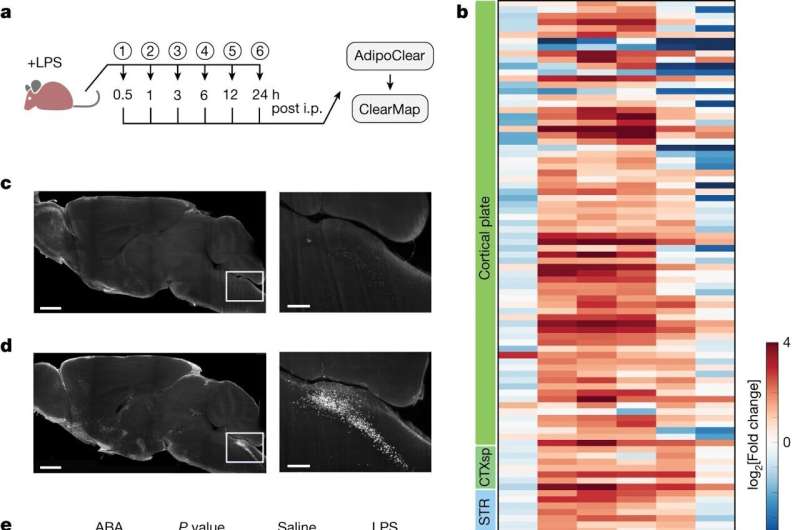
The researchers first injected them with lipopolysaccharide, a bacterial endotoxin, rather than infecting them directly—this allowed for more consistent symptoms. They then conducted brain scans on the mice multiple times over 24 hours to learn more about what was happening in the brain as it initiated illness symptoms. They found that shortly after the first injection, a subset of neurons in the brainstem called the nucleus of the tract (NTS) became active, as did the area postrema (AP). Prior research has shown that the NTS receives signals from the large intestine and the AP is constantly bathed in humoral factors.
The researchers then used a technique called TRAP2 to activate the neural group in test mice who did not receive injections of lipopolysaccharide. These mice exhibited the same illness symptoms as those mice who had received the injections. They also found that inhibiting the nerve groups in mice who did have the injection greatly reduced illness symptoms.
Next, the researchers conducted RNA sequencing on the cells in the nerve groups they had identified—that allowed them to identify the particular neurons within the clusters they had identified that were responsible for initiating illness symptoms.
Source: Read Full Article